
 Image 1 of 1
By The Cover examines the instinct to decide who someone is before knowing what exists beneath the surface.
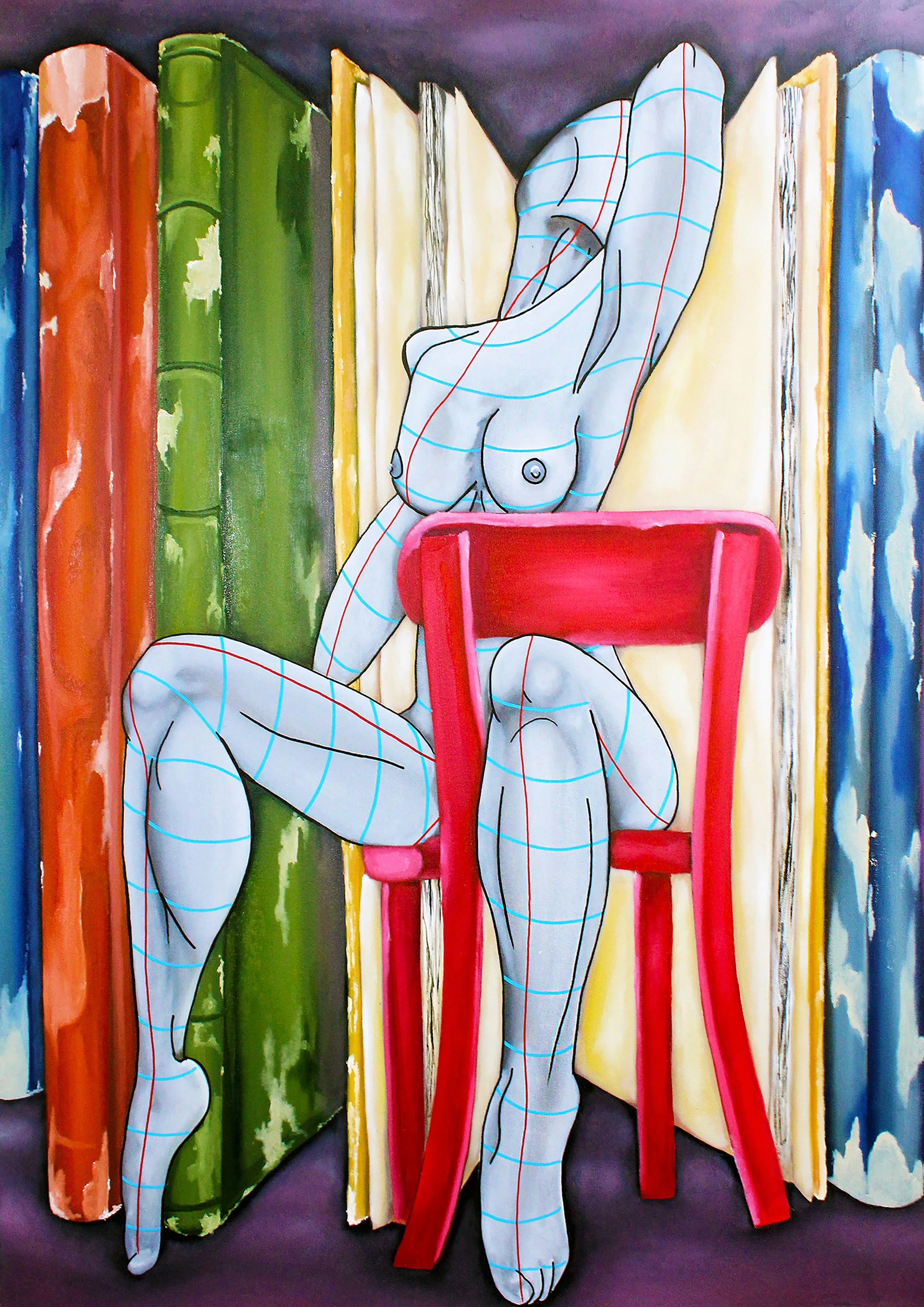
One of the Paper People sits exposed between towering books, the figure’s body framed by worn covers and open pages. Their skin is made of notebook paper, defined by the familiar blue and red ruled lines of the page itself. With clothing and other markers of status removed, the figure is presented without many of the visual cues people often use to categorize, judge, or understand one another.
The title By The Cover draws from the familiar warning not to judge a book by its cover.
We constantly read people before we know them.
Their appearance. Their body. Their clothing. Their race. Their gender. Their success. Their mistakes. The fragments we can see often become the story we assume we understand.
The work continues the mythology of the Paper People: figures born from scrapped potential who exist between civilization and chaos. Their notebook-paper skin speaks directly to that origin. Like blank pages, they begin without a predetermined story. They transcend race, culture, emotion, and expectation. Though human in form, they are not bound by society’s definitions or stereotypes. They are undefined, unrestricted, and free to write their own destiny.
In By The Cover, the relationship between the body and the book becomes literal. The Paper People are surrounded by objects created to hold stories while their own bodies are made from the material upon which stories are written.
Yet the pages surrounding the figure cannot tell us who they are.
The exposed body introduces vulnerability, but it also removes disguise. Without clothing or an obvious social role, the viewer is left searching for another way to interpret the figure. The oversized books become both shelter and confinement, suggesting the narratives, labels, histories, and assumptions that can surround a person before they ever have the opportunity to define themselves.
The red chair places the figure somewhere between comfort and discomfort, visibility and concealment. The Paper People appear physically present, yet their story remains unavailable to us.
We can see the cover.
We can see the pages.
But we still have not read the story.
What you see may be part of someone’s story. It is never the whole book.
By The Cover is an expressive contemporary artwork exploring identity, judgment, vulnerability, perception, stereotypes, self-definition, and the distance between how a person appears and who they actually are.
By The Cover examines the instinct to decide who someone is before knowing what exists beneath the surface.
One of the Paper People sits exposed between towering books, the figure’s body framed by worn covers and open pages. Their skin is made of notebook paper, defined by the familiar blue and red ruled lines of the page itself. With clothing and other markers of status removed, the figure is presented without many of the visual cues people often use to categorize, judge, or understand one another.
The title By The Cover draws from the familiar warning not to judge a book by its cover.
We constantly read people before we know them.
Their appearance. Their body. Their clothing. Their race. Their gender. Their success. Their mistakes. The fragments we can see often become the story we assume we understand.
The work continues the mythology of the Paper People: figures born from scrapped potential who exist between civilization and chaos. Their notebook-paper skin speaks directly to that origin. Like blank pages, they begin without a predetermined story. They transcend race, culture, emotion, and expectation. Though human in form, they are not bound by society’s definitions or stereotypes. They are undefined, unrestricted, and free to write their own destiny.
In By The Cover, the relationship between the body and the book becomes literal. The Paper People are surrounded by objects created to hold stories while their own bodies are made from the material upon which stories are written.
Yet the pages surrounding the figure cannot tell us who they are.
The exposed body introduces vulnerability, but it also removes disguise. Without clothing or an obvious social role, the viewer is left searching for another way to interpret the figure. The oversized books become both shelter and confinement, suggesting the narratives, labels, histories, and assumptions that can surround a person before they ever have the opportunity to define themselves.
The red chair places the figure somewhere between comfort and discomfort, visibility and concealment. The Paper People appear physically present, yet their story remains unavailable to us.
We can see the cover.
We can see the pages.
But we still have not read the story.
What you see may be part of someone’s story. It is never the whole book.
By The Cover is an expressive contemporary artwork exploring identity, judgment, vulnerability, perception, stereotypes, self-definition, and the distance between how a person appears and who they actually are.