
 Image 1 of 1
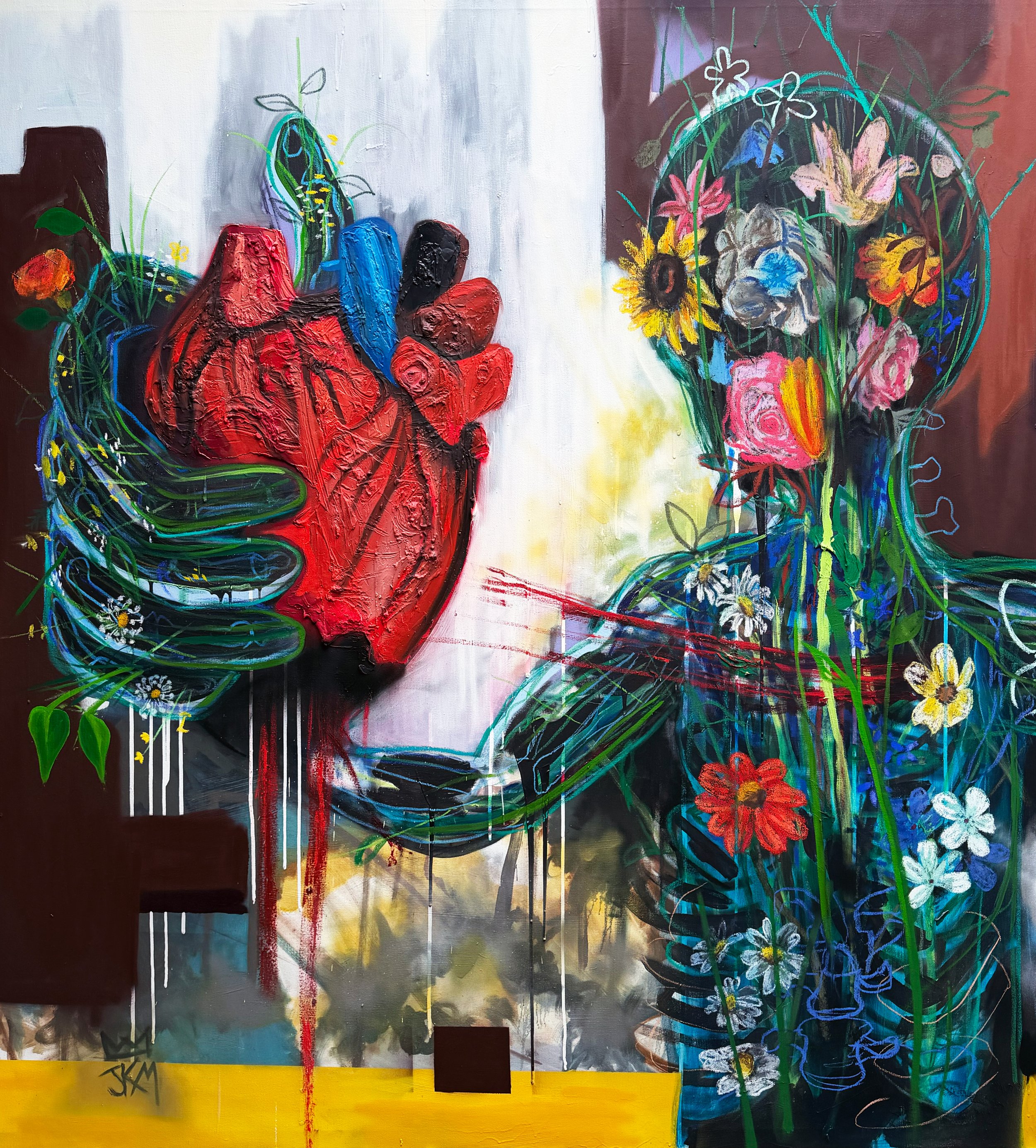
Misfire is the first painting in the Earthlings series.
The Earthlings are post-human figures composed of multiple flowering plants cohabiting a single body, each one a living ecosystem oriented toward a singular collective purpose. Every figure carries within its botanical composition the accumulated symbolic histories of the world’s flowering species, an inheritance written into the body before it reaches the mind.
This work operates at the intersection of ecology, post-humanism, and diaspora. Through ecology, it proposes coexistence not as an ideal, but as a biological fact: distinct species, distinct histories, sustaining a single living form. Through post-humanism, it asks what consciousness looks like when it emerges outside the human, what survives, what transforms, and what reveals itself as never having belonged to one species alone. Through diaspora, the figure becomes a carrier of layered inheritances, holding dispersed histories inside a shared body.
In Misfire, the Earthling depicted has been caught in the crossfire of war. A missile has gone through its heart.
At the center of the composition, the figure extends its hand toward a detached anatomical heart, vivid, wounded, and bleeding. The body itself is made of flowers, stems, and living growth, a blooming form that remains animate even in the presence of violence. The painting holds together rupture and resilience, tenderness and devastation, beauty and harm.
The title Misfire carries a double meaning. It suggests both a weapon gone astray and a failure in the moral and spiritual systems meant to protect life. In that sense, the work is not only about a wound to one figure. It is about a wound to the possibility of universal love and peace.
The missile passing through the heart becomes symbolic of a broader human condition. It asks what happens when the center of care, compassion, and shared survival is pierced by conflict. The Earthling remains standing, but injured. It continues to bloom, but under threat. Life persists, even as peace becomes increasingly fragile.
As the first work in the series, Misfire introduces the Earthlings through crisis. It establishes them not as fantasy creatures, but as living embodiments of interdependence. Their bodies make visible a truth the world often resists: no life exists alone, and violence against one form of life inevitably reaches beyond its target.
Misfire is a meditation on universal love, peace, fragility, and survival. It asks what it means to protect life in a world increasingly organized around destruction, and whether something collective and living can still endure after the heart has been struck.
Even wounded, the Earthling blooms. Even pierced, the heart insists on life.
Misfire is a contemporary artwork exploring war, universal love, peace, ecological interdependence, post-human consciousness, diaspora, fragility, and the persistence of life under threat.
Misfire is the first painting in the Earthlings series.
The Earthlings are post-human figures composed of multiple flowering plants cohabiting a single body, each one a living ecosystem oriented toward a singular collective purpose. Every figure carries within its botanical composition the accumulated symbolic histories of the world’s flowering species, an inheritance written into the body before it reaches the mind.
This work operates at the intersection of ecology, post-humanism, and diaspora. Through ecology, it proposes coexistence not as an ideal, but as a biological fact: distinct species, distinct histories, sustaining a single living form. Through post-humanism, it asks what consciousness looks like when it emerges outside the human, what survives, what transforms, and what reveals itself as never having belonged to one species alone. Through diaspora, the figure becomes a carrier of layered inheritances, holding dispersed histories inside a shared body.
In Misfire, the Earthling depicted has been caught in the crossfire of war. A missile has gone through its heart.
At the center of the composition, the figure extends its hand toward a detached anatomical heart, vivid, wounded, and bleeding. The body itself is made of flowers, stems, and living growth, a blooming form that remains animate even in the presence of violence. The painting holds together rupture and resilience, tenderness and devastation, beauty and harm.
The title Misfire carries a double meaning. It suggests both a weapon gone astray and a failure in the moral and spiritual systems meant to protect life. In that sense, the work is not only about a wound to one figure. It is about a wound to the possibility of universal love and peace.
The missile passing through the heart becomes symbolic of a broader human condition. It asks what happens when the center of care, compassion, and shared survival is pierced by conflict. The Earthling remains standing, but injured. It continues to bloom, but under threat. Life persists, even as peace becomes increasingly fragile.
As the first work in the series, Misfire introduces the Earthlings through crisis. It establishes them not as fantasy creatures, but as living embodiments of interdependence. Their bodies make visible a truth the world often resists: no life exists alone, and violence against one form of life inevitably reaches beyond its target.
Misfire is a meditation on universal love, peace, fragility, and survival. It asks what it means to protect life in a world increasingly organized around destruction, and whether something collective and living can still endure after the heart has been struck.
Even wounded, the Earthling blooms. Even pierced, the heart insists on life.
Misfire is a contemporary artwork exploring war, universal love, peace, ecological interdependence, post-human consciousness, diaspora, fragility, and the persistence of life under threat.