
 Image 1 of 1
Pothead explores the body as a site of cultivation, memory, concealment, and becoming.
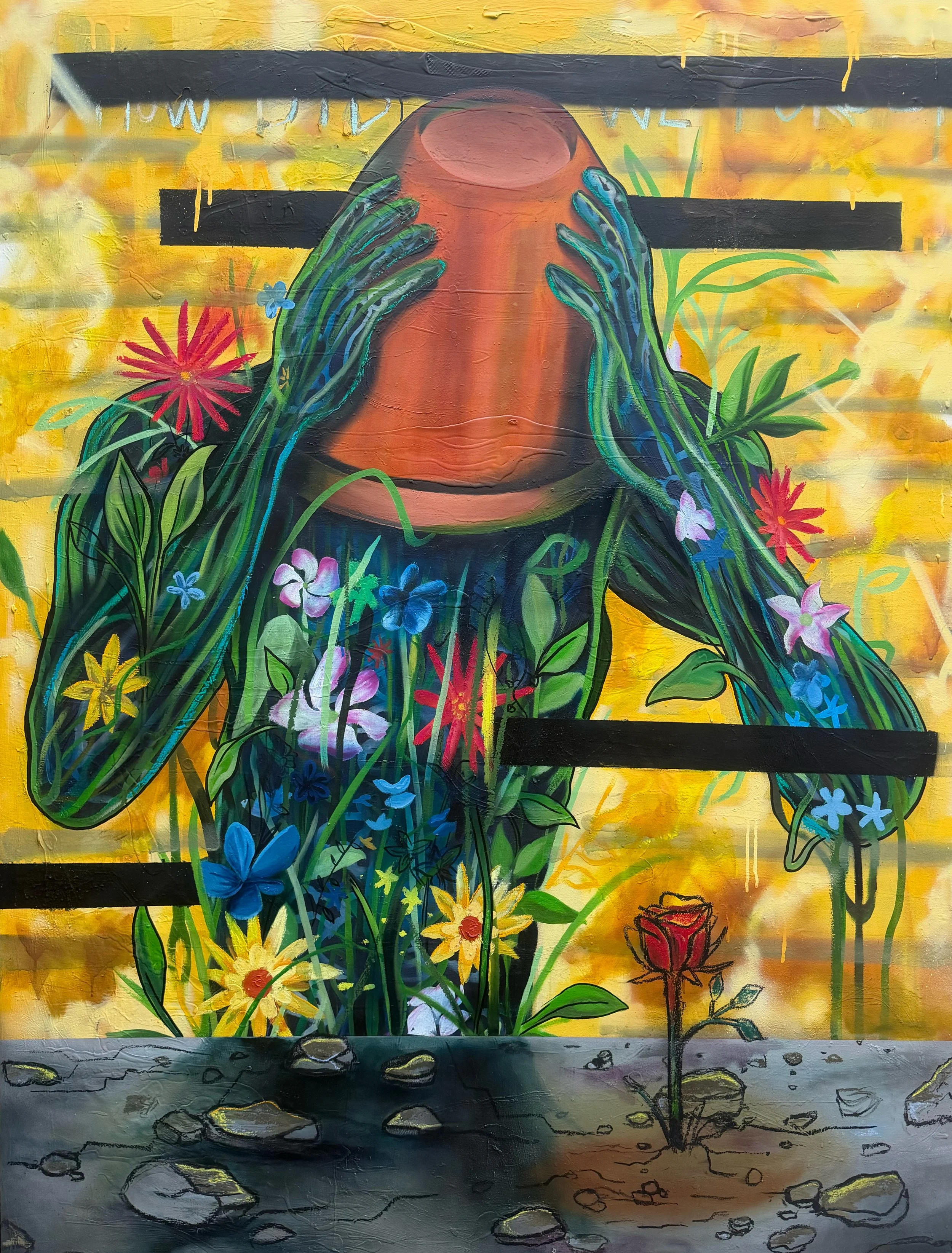
At the center of the composition stands a figure whose head has been replaced by a terracotta flowerpot. From the body, vines, stems, and blossoms grow outward in every direction, turning the figure into both person and garden. Bright flowers emerge from the torso and arms, while a single red rose rises from a cracked strip of ground below. Behind the figure, the words “How Did We Forget” appear across the yellow field, partially interrupted by black bars that function as redactions.
That detail shifts the work toward memory and erasure.
The title Pothead plays with humor, language, and image, but beneath that play lies a deeper meditation on what we cultivate within ourselves and what we obscure, suppress, or forget. A pot is a container. It holds soil, roots, possibility, and life in progress. By making the head a vessel, the work suggests that the self is not fixed or closed. It is something planted, cultivated, and capable of holding more than appears on the surface.
The phrase “How Did We Forget” introduces a sense of loss and interruption. It suggests a forgetting that may be personal, cultural, ancestral, or historical. The black bars do not simply divide the composition visually. They operate as redactions, implying censorship, omission, and the deliberate blocking of knowledge or memory. What is being forgotten, and who benefits from that forgetting?
At the same time, the figure continues to bloom.
That is what makes the work powerful. Even with redaction, growth persists. Flowers keep emerging from the body. Softness survives. Beauty survives. Life insists on itself even when language, history, or memory has been obscured.
The lone rose in the foreground becomes especially important. Separated from the body yet clearly connected to the same world, it suggests survival under pressure. It rises from cracked ground and rubble, reminding us that growth often appears where conditions seem least able to sustain it.
In this way, Pothead holds together several tensions at once:
Containment and expansion.
Memory and erasure.
Fragility and resilience.
Restriction and flourishing.
The cultivated self and the censored self.
The work also connects to a broader concern in my practice: the environment inside. Here, the body is not just a figure to be looked at. It is a living ecosystem carrying the evidence of what has been nurtured, what has been suppressed, and what still finds a way to bloom.
Pothead is a contemporary artwork exploring growth, memory, censorship, erasure, self-cultivation, resilience, transformation, and the quiet insistence of becoming.
Pothead explores the body as a site of cultivation, memory, concealment, and becoming.
At the center of the composition stands a figure whose head has been replaced by a terracotta flowerpot. From the body, vines, stems, and blossoms grow outward in every direction, turning the figure into both person and garden. Bright flowers emerge from the torso and arms, while a single red rose rises from a cracked strip of ground below. Behind the figure, the words “How Did We Forget” appear across the yellow field, partially interrupted by black bars that function as redactions.
That detail shifts the work toward memory and erasure.
The title Pothead plays with humor, language, and image, but beneath that play lies a deeper meditation on what we cultivate within ourselves and what we obscure, suppress, or forget. A pot is a container. It holds soil, roots, possibility, and life in progress. By making the head a vessel, the work suggests that the self is not fixed or closed. It is something planted, cultivated, and capable of holding more than appears on the surface.
The phrase “How Did We Forget” introduces a sense of loss and interruption. It suggests a forgetting that may be personal, cultural, ancestral, or historical. The black bars do not simply divide the composition visually. They operate as redactions, implying censorship, omission, and the deliberate blocking of knowledge or memory. What is being forgotten, and who benefits from that forgetting?
At the same time, the figure continues to bloom.
That is what makes the work powerful. Even with redaction, growth persists. Flowers keep emerging from the body. Softness survives. Beauty survives. Life insists on itself even when language, history, or memory has been obscured.
The lone rose in the foreground becomes especially important. Separated from the body yet clearly connected to the same world, it suggests survival under pressure. It rises from cracked ground and rubble, reminding us that growth often appears where conditions seem least able to sustain it.
In this way, Pothead holds together several tensions at once:
Containment and expansion.
Memory and erasure.
Fragility and resilience.
Restriction and flourishing.
The cultivated self and the censored self.
The work also connects to a broader concern in my practice: the environment inside. Here, the body is not just a figure to be looked at. It is a living ecosystem carrying the evidence of what has been nurtured, what has been suppressed, and what still finds a way to bloom.
Pothead is a contemporary artwork exploring growth, memory, censorship, erasure, self-cultivation, resilience, transformation, and the quiet insistence of becoming.